The Sweet Journey: How Honey is Produced from Hive to Jar
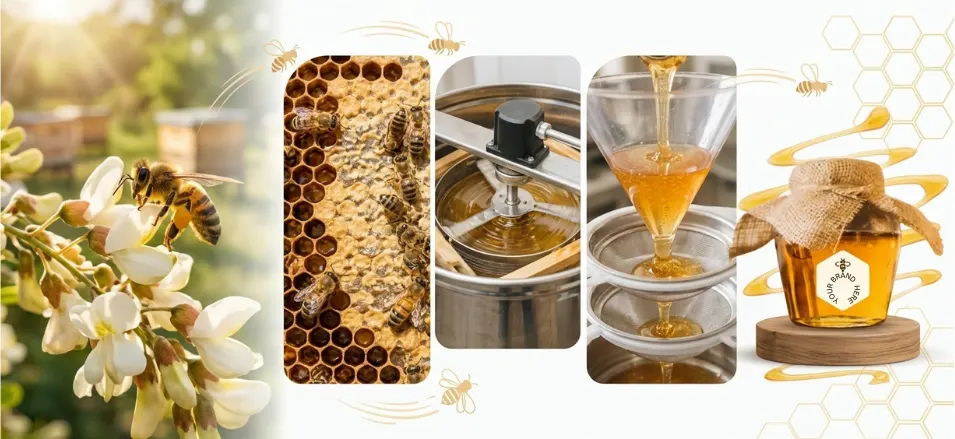
Honey is one of the few foods that doesn’t really begin in a factory. It begins outdoors, in fields, around flowers, with bees doing something they’ve always done.
So when someone asks how is honey produced, the answer isn’t quick or mechanical. It’s a slow, natural journey that moves from hive to handling, and finally into a jar. Let’s walk through it the way it actually happens.
How Do Honey Bees Make Honey?
Everything begins with a single, quiet action. A bee landing on a flower. There’s no rush. Just a steady rhythm.
Bees collect nectar, the naturally sweet liquid found deep inside flowers. With the help of their long tongues, they pull out the nectar and store it in another part of their body called the honey stomach.
Here’s how the process goes:
Nectar collection by worker bees
One worker bee could be collecting nectar from as many as hundreds of flowers, collecting small drops of nectar, which slowly add up to something worthwhile.
Enzyme transformation
The nectar inside the bee’s body starts to transform, with the help of enzymes, which break down the nectar into something that easier to store.
Transfer between bees
The nectar is passed along, bee to bee, like a quiet handover. Each step refines it further.
Evaporation process
Bees spread the liquid across honeycomb cells and fan it with their wings. Moisture slowly disappears.
Sealing the honey
Once it thickens, the bees seal it with wax. That is their signal. It is ready./
How Is Honey Produced in Modern Beekeeping?
Now, as the bees are producing the honey, the process doesn’t stop there. Beekeepers are involved, not in interfering with the process, but in facilitating it.
So when people ask how is honey produced and collected, the answer sits somewhere between nature and careful human involvement.
The process of honey production in real-time is as follows:
1. Hive Management
Beekeepers check on the beehives. Not in a disruptive way, but enough to make sure everything is balanced. Healthy bees, enough space, access to flowers. It all matters.
2. Honeycomb Formation
Inside the hive, bees build wax structures. These honeycombs are where everything happens. Storage, transformation, preservation.
3. Ripening Stage
Fresh nectar is not honey yet. It needs time. Bees reduce the moisture naturally, turning it into something stable and long-lasting.
4. Inspection & Timing
This is where experience shows. Harvest too early, and the honey isn’t ready. Wait too long, and you risk losing efficiency. Beekeepers watch for sealed cells. That’s the sign.
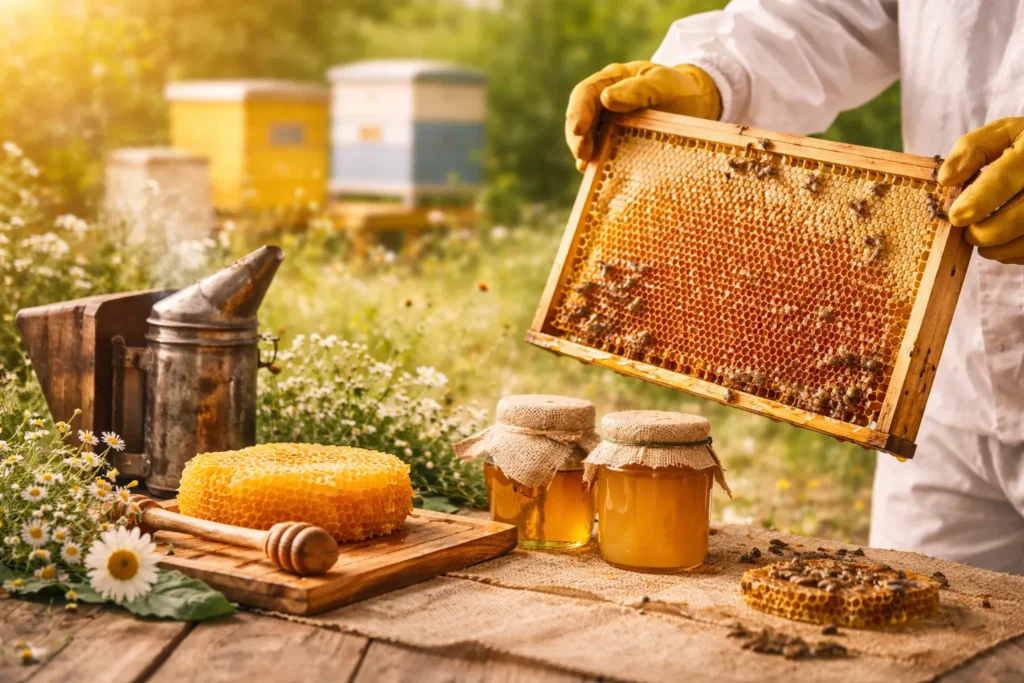
There’s a quiet patience in this stage. Nothing is rushed, because it can change the outcome.
Bee Honey Harvesting: The First Step Beyond the Hive
Once the honey is ready, it finally leaves the hive. This step, known as bee honey harvesting, is more delicate than it sounds. The honey is to be taken without disturbing the bees any further than is necessary.
Here’s how it’s normally done:
- Removing the frames: The honey-filled frames are carefully lifted out. No sudden movements.
- Brushing off bees: Bees are gently guided away, not forced. The idea is to keep the colony calm.
- Uncapping the cells: Each honeycomb cell is sealed with a thin layer of wax. That layer is removed to access the honey.
- Extraction of honey: The frames are then put into a machine which spins them around. Through this spinning motion, which is known as centrifugal force, the honey comes out slowly at the base of the machine. Beekeepers also extract honey from the cells by hand, which can take longer than a machine.
At this point, it is raw. It has bits of wax, small particles, remnants of where it came from, and has not been shaped yet. Just collected.
Also read: The Journey Behind Every Drop of Honey
From Hive to Jar Honey: Processing with Purpose
People often say from hive to jar honey, but there’s a meaningful stretch in between. After extraction, honey needs to be handled with care. Not processed in a heavy-handed way, but cleaned and stabilised just enough.
Here’s what happens next:
1. Straining and Filtration
The honey is passed through fine filters. This removes wax fragments and natural debris while keeping the core of the honey untouched.
2. Settling
It is then left to sit. No movement. Over time, air bubbles rise to the surface, leaving the honey clearer.
3. Moisture Control
This part is important. If moisture is too high, honey can ferment. So levels are checked and balanced. The moisture content in honey needs to be below 20°C.
4. Quality Checks
Each batch is examined. Texture, purity, consistency. Everything is measured without overcomplicating the product.
5. Packaging
Finally, it is poured into jars under clean, controlled conditions. This is where an experienced honey manufacturer makes a difference. The role is not to change the honey, but to protect what it already is.
At Ess Pee Quality Products, we focus on certified quality, ensuring that what reaches you still feels close to its origin.
How Is Honey Mass Produced Without Losing Its Natural Value?
Honey is in demand. And naturally, production needs to keep up. But here’s the important part. Scaling honey is not about speeding it up. So, how is honey mass produced without losing what makes it natural?
It comes down to systems, not shortcuts.
- Sourcing from multiple apiaries: Instead of relying on one source, honey is collected from different regions. This keeps supply steady and ecosystems supported.
- Standardised processing systems: Equipment is designed to handle volume without overheating or damaging the honey.
- Strict quality testing: Every batch is checked. No assumptions. Only verified quality.
- Traceability systems: The origin of the honey is tracked. You know where it comes from.
A trusted Honey Manufacturer understands that balance. Scale matters, but not at the cost of quality.
Bring Home Better Sweetness
Looking for honey that feels natural, reliable, and thoughtfully made? Start with a range crafted with quality at its core.
Explore NowWhy Understanding Honey Production Matters
Most people reach for honey because it feels like a better choice. But understanding how is honey produced adds another layer to that decision.
You start to notice the difference. Between something that is just sweet, and something that is carefully made.
It helps in:
- Choosing an authentically sourced honey
- Valueing the ethical sourcing and beekeeping practices
- Supporting the production process that respects the nature and quality
For anyone focused on health, this becomes even more relevant. You’re not just adding sweetness. You’re choosing something that has been handled with care from start to finish.
Final Thoughts
Honey doesn’t begin in a jar. It begins quietly, out in the open, with bees moving from flower to flower.
From that first drop of nectar to careful bee honey harvesting, and finally the journey from hive to jar honey, every step follows its own pace.
Nothing is rushed or forced. It is created by nature at its own pace. We simply make sure it reaches you the right way.

In This Blog